

Hospitality Team Coaching for Leadership Teams
Hospitality team coaching exists because some problems do not sit inside any one person. They sit between people, which is why coaching them one at a time rarely moves anything.
Hospitality team coaching works on the leadership team as one unit because some of the most expensive problems in a hotel or a restaurant group do not sit inside any individual. They sit in the space between two roles.
Cornerstone Hospitality runs this work for executive committees, regional leadership groups, and ownership teams. Our consultants came from operating careers, which matters in a room like this: a team can tell within minutes whether the person facilitating has ever carried a P & L in hospitality or only read about one.
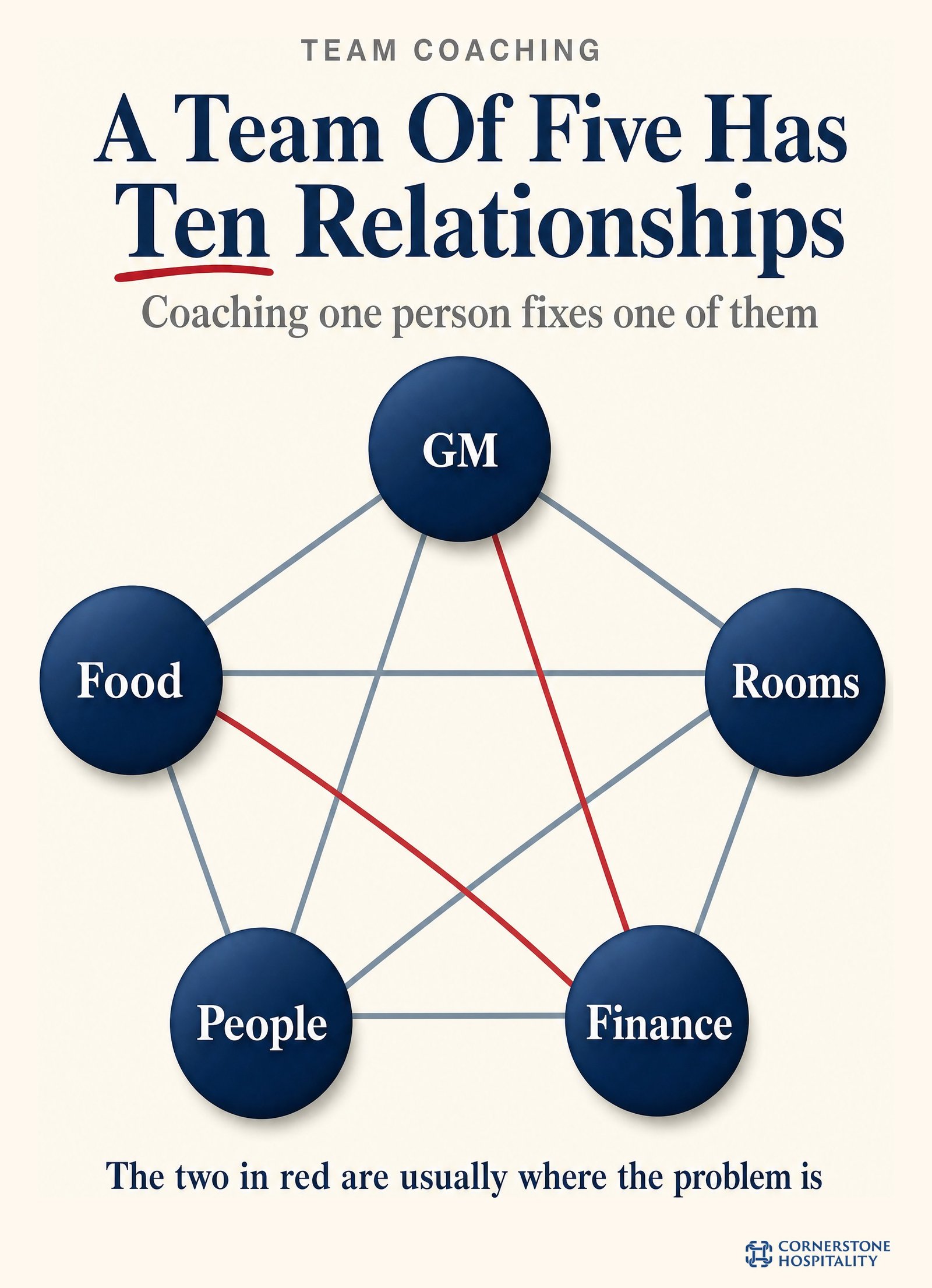
A team of five has ten relationships
The arithmetic here is the whole argument. Five people are not five things to manage. It is ten pairs, and each pair either works or quietly costs something.
Coaching one of those five individually improves one person’s contribution to four of the ten pairs, on a good day. The other six are untouched, and if the real trouble sits in one of them, the money has bought a better version of a leader who is still walking into the same wall.
Almost every executive committee we meet has one or two pairs that everybody knows about and nobody names. Food and Rooms or Finance and the GM. The pair that has to negotiate the same thing every month and has developed a workaround instead of an agreement.
Team coaching addresses those directly, in the room, with everyone present. That is uncomfortable by design, and it is why the format exists.
When a team needs hospitality team coaching rather than a hire
Owners often reach for a replacement when the symptom is a team problem, and the replacement inherits the same dynamic within a quarter.
The tell is repetition. If the same friction survived the last two people who held the seat, the seat is not the issue. Something in how the group operates is producing it, and hiring again is an expensive way to find that out twice.

Hospitality team coaching when it is the same friction, third person in the seat?
Tell us what keeps recurring, and we will tell you honestly whether this is the right tool.
What hospitality team coaching is and is not
It is regularly confused with two other things, and it behaves nothing like either.
| A team offsite | Individual coaching | Team coaching | |
|---|---|---|---|
| What it works on | Strategy and plans | One leader | How the group operates together |
| How long | One or two days | Six to twelve months | Six to nine months |
| Who is present | Everyone | One person | Everyone, repeatedly |
| What changes | The plan | One person’s behavior | What the group tolerates |
| Where it fails | Nothing carries into Monday | The pairs stay untouched | When one member is not willing |
Individual coaching runs alongside the group work in most of our engagements. They are complements, not alternatives.
Where a team is actually uneven
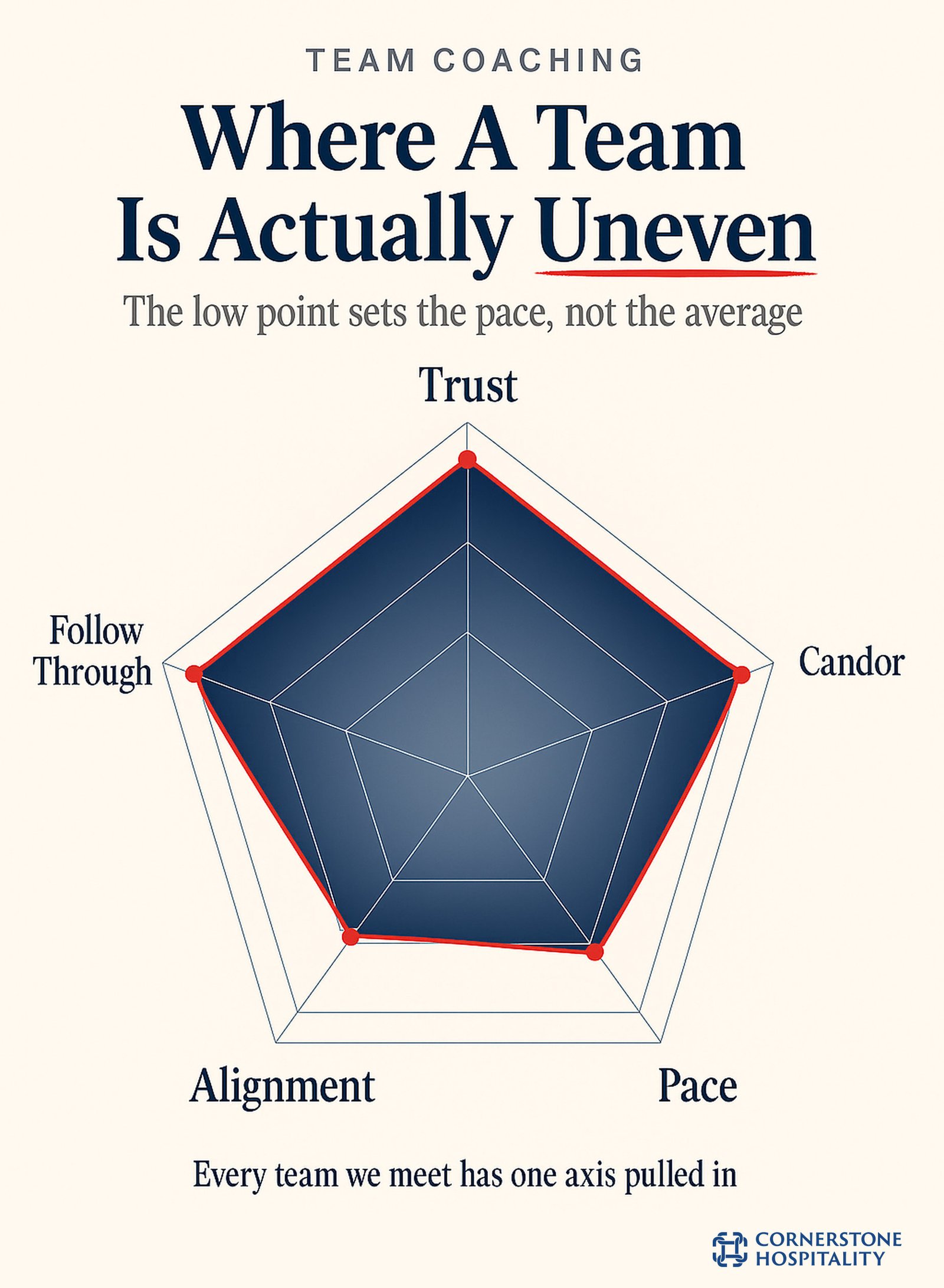
Leadership teams are rarely weak everywhere. They are strong on most dimensions and badly short on one, and the short one sets the ceiling for all of it.
Trust is whether people are willing to be seen getting something wrong. Candor is whether the disagreement happens in the meeting or in the corridor afterward. Pace is whether decisions get made at the speed the business actually moves at.
Alignment is whether the group leaves the room describing the same decision. Follow-through is whether Tuesday’s agreement is still being done six weeks later, unchased.
Almost every team we meet has one or two of those five pulled in, and the pulled-in one sets the ceiling. The work is naming which one, honestly, in front of each other, and then living differently for long enough that it holds.
How hospitality team coaching runs
Individual conversations
A confidential conversation with each member before any group session, so the room starts from what is actually true.
Group sessions
Monthly working sessions with the whole team, aimed at the named pairs and the axis that is pulled in.
Between and after
Individual work alongside the group and a review at the end that says what the team now owns itself.

Frequently asked questions about hospitality team coaching
What is hospitality team coaching?
Structured work with a leadership team as a single unit, over months, aimed at how the group operates together rather than at any one member. It runs alongside individual coaching rather than instead of it.
How is it different from a team offsite?
An offsite works on the plan over one or two days. Team coaching works on what the group tolerates, over six to nine months, with the same people in the room repeatedly. Offsites produce agreement. Coaching produces different behavior, which takes considerably longer.
How big can the team be?
Four to eight works best. Below four, the dynamic is really a pair or a triangle and is better handled as such. Above eight, the room stops being a working session and starts being an audience.
What if one member does not want to take part?
That is the single most common reason these engagements fail, so we surface it in the individual conversations before the first group session. Every so often it is resolvable. Sometimes it is the finding, and the honest answer is that the team problem is a personnel decision.
Is what people say in the room confidential?
What is said in the group is shared by the group. What is said in an individual conversation stays there unless the person agrees to bring it into the room, and a great deal of the work is helping them do exactly that.
Can it run across multiple properties?
Yes. Regional leadership teams who see each other quarterly are typically the ones who need it most, because distance lets a workaround harden into a habit that nobody has to face.
Is the problem the person or the team?
If the same friction has outlived two people in the seat, it is worth an honest conversation before the third hire. No commitment, no charge.
Sources and references
- Korn Ferry Institute, Stronger Leadership, Stronger Climate, Better Results: analyzes “data from over 2,700 individuals across 541 teams” and finds that “team climate accounted for up to 31% of the variation in team-level engagement”. It reports that the right leadership characteristics and team environment “can lift engagement scores by up to 42 percentile points”, and that leaders scoring high on Presence, Agility and Striving produced team climates “approximately 30 percentile points stronger” than lower-scoring leaders.
- International Coaching Federation, Coaching Statistics: The ROI of Coaching in 2024: reports that “87% of survey respondents agreed that executive coaching has a high return on investment” and cites a PricewaterhouseCoopers and Association Resource Center global survey finding “an average ROI of seven times the cost of employing a coach”. It further records 72% of respondents linking coaching to increased employee engagement, with approval of coaching running at 78% among senior executives and 73% among employees.