

Senior Leadership Program for Hotels and Travel
A senior leadership program for leaders : the step from operator to business leader
A senior leadership program is for the point where being excellent at the operation stops being enough, and where the habits that got someone promoted start quietly working against them.
Cornerstone Hospitality builds that work for leaders in hotels, resorts, restaurant groups and travel operators. The consultants delivering it held senior operating roles first, which matters here more than anywhere: the step being described is one they have made.
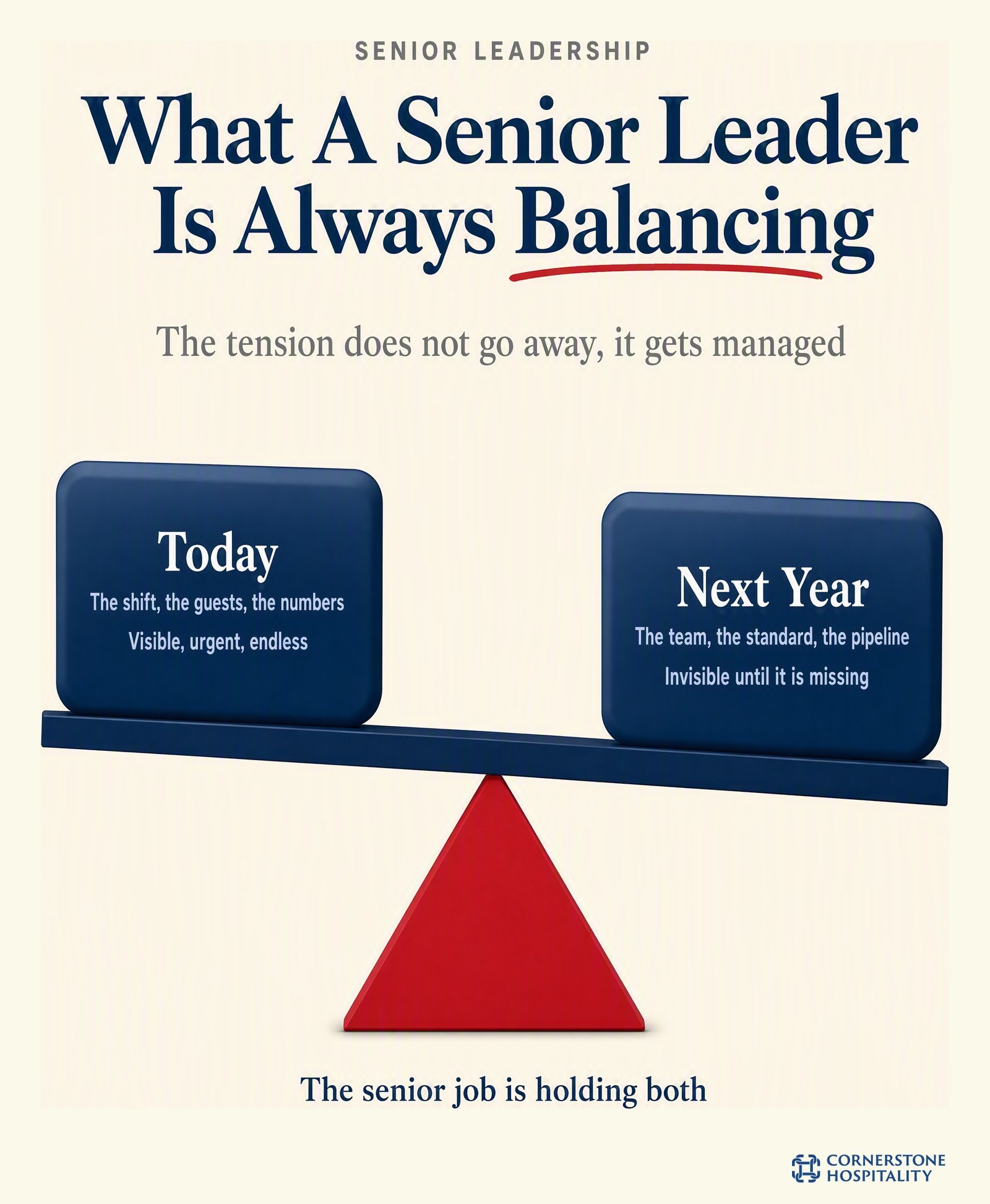
What a senior leader is always balancing
Every senior job in this industry is the same tension held at a larger scale. Today is loud. Next year is silent until it is missing.
Today is the shift, the guests, the covers, the month end. It is visible, it is urgent, and there is always more of it. It also gives immediate feedback, which is why a strong operator can spend a year there and feel effective throughout.
Next year is the team, the standard and the bench. None of it announces itself, none of it is urgent this morning, and all of it is what the property will be judged on when the person in the seat moves on.
The senior job is not choosing between them. It is holding both, deliberately, when only one of them is asking.
The step from operator to business leader
Operational excellence is a habit of solving. At a senior level the same reflex becomes the constraint, because a leader who solves everything builds a team that brings everything.
The work is rarely about adding knowledge. It is about which instinct to stop trusting, and that is uncomfortable enough that it needs someone credible sitting opposite.

A senior leadership program for the seat above the one they hold?
Tell us where they are now and where the business needs them to be.
What a senior leadership program changes
The same person, a different job.
| Running the operation | Leading the business | |
|---|---|---|
| The main skill | Solving what is in front of you | Deciding what not to solve yourself |
| Feedback | Immediate, every shift | Delayed, sometimes by a year |
| Who you answer to | A department, a brand standard | An owner, a board, a P and L |
| What good looks like | The day went well | The team held it without you |
Most senior appointments that come undone were operationally strong and were never taken through that second column.
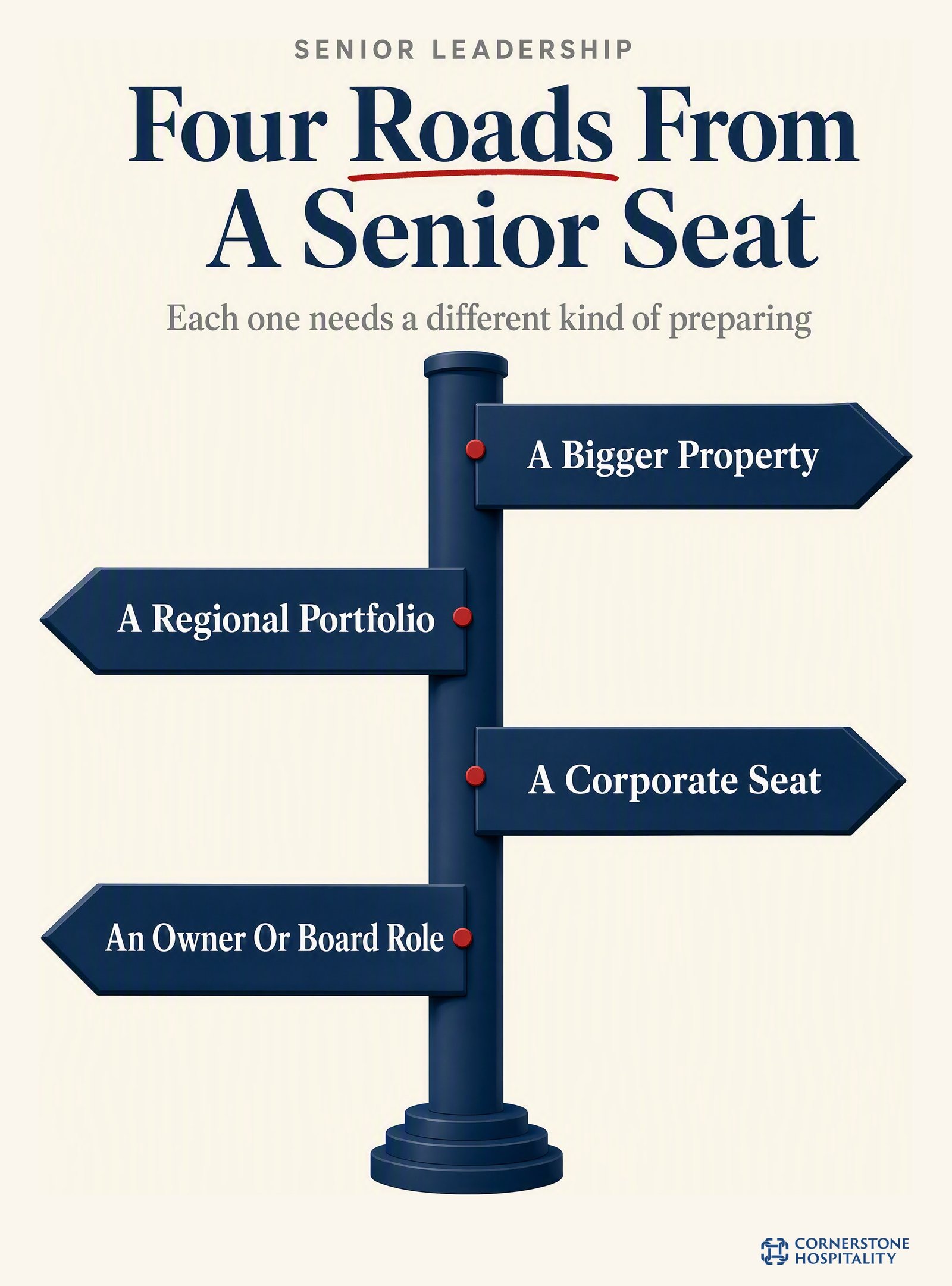
Four roads out of a senior leadership program
Senior does not mean one destination. The four common next moves need genuinely different preparation, and treating them as one ladder is why people arrive underprepared.
A bigger property is the most familiar step and the most underestimated: the job is recognizable, the scale of consequence is not. A regional portfolio is a different discipline, because the leader stops running anything directly and holds a standard across buildings they are not standing in.
A corporate seat asks for influence without operational authority, unfamiliar territory for someone used to being the final word on their own floor. An owner or board role changes the question entirely, from how well the business runs to whether it is the right business.
Naming the road early changes what the program works on, which is why it is one of the first conversations we have.
How a senior leadership program is built
Name the road
Which of the four next moves this is actually preparing for, agreed with the leader and the sponsor.
Baseline and plan
A 360 read from the people around them, then a written plan with named behavioral targets.
Work and review
Two to four sessions a month with access between, and three milestone reviews against the plan.
Frequently asked questions about senior leadership programs
Who is a senior leadership program actually for?
Leaders who already run something and are moving toward a seat where operational command stops being the main skill. General managers, executive committee members, regional directors and corporate executives.
Is it different from executive coaching?
The mechanics are similar, and the framing is different. A senior program is anchored to a named next step rather than to a general improvement in effectiveness, and the plan is written against that step.
What if the leader is not sure which road they want?
That is a legitimate starting point and often the most valuable early work. Choosing between a bigger property, a portfolio, a corporate seat and a board role is a real decision, and making it deliberately beats drifting into whichever vacancy appears first.
Can the sponsor see progress?
Yes. The written plan, the named targets and three milestone reviews are visible to whoever is sponsoring the work. What is said inside a session is not.
Does it work for someone already struggling?
Often, provided the constraint is genuinely developmental. If the appointment itself was wrong, a program will not fix it, and we will say so rather than take the engagement.
Can it run alongside a live search?
Yes, and the two inform each other. Many of the leaders we develop were placed by us, and the read from a development engagement makes the next appointment sharper.
Getting a senior leader ready for the next seat?
Start with the road they are actually on. We will tell you what the step genuinely asks for.
Sources and references
- Center for Creative Leadership, The 70-20-10 Rule for Leadership Development: sets out the framework that “emerged from over 30 years of our Lessons of Experience research”, in which development divides into “70% challenging experiences and assignments, 20% developmental relationships, 10% coursework and training”. CCL notes the framework is drawn from research spanning China, India, Singapore and the United States and is used across a client base including two thirds of the Fortune 1000.
- The Future Organization, interview with Michael Watkins, The First 90 Days: Strategies for Leaders in Transition: records Watkins stating that “unaided the process for leaders to reach the breakeven point can take up to six months”, the breakeven point being where a leader contributes as much value as they have consumed. He also observes that “most people spend 10 to 15 years in leadership positions before getting any formal leadership training from their organization”, with the average leader in their late thirties or early forties before any training at all.
For the broader picture this fits into, see our Leadership Development work.