

Corporate Leadership Programs for Hospitality
Corporate leadership programs for hotel groups, restaurant companies and travel operators, built around the leaders you already employ.
Corporate leadership programs are usually bought for a cohort rather than a person. That changes what good looks like: not one leader who improves, but a layer of the business that gets stronger and stays.
Cornerstone Hospitality builds cohort programs for hotel groups, restaurant companies and travel operators. The consultants delivering them held senior operating roles in the sector first, so the work starts from the operating reality of the group rather than from a generic leadership curriculum.
What corporate leadership programs are really buying
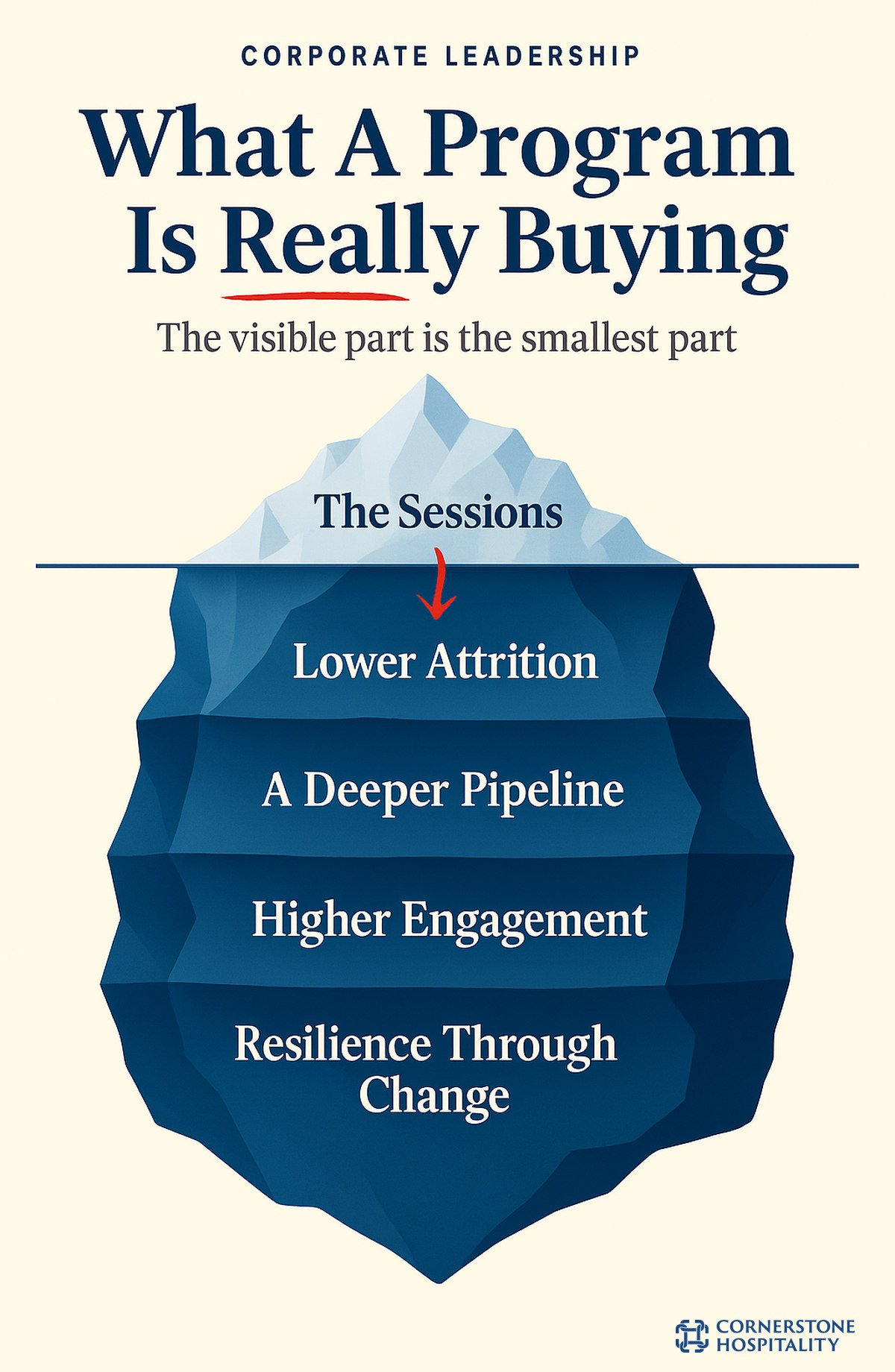
The sessions are the visible part, and they are the smallest part. What a group is actually paying for sits underneath, and it is measurable.
Lower attrition comes first, because in an industry this dependent on people, losing a strong department head is expensive twice: once in the vacancy and again in what the team does while the seat is empty. A deeper pipeline follows, which is what lets a group promote from inside rather than paying a premium to buy in a stranger every time a property changes hands.
Higher engagement across properties is the third, and it is the one owners feel in guest scores before they see it anywhere else. The fourth is resilience: a leadership layer that leads through change rather than absorbing it, which matters more in a sector where ownership, brand and strategy all move.
Talent development is an investment, not an event
In hospitality your people are your product. The gap between good brand performance and the kind that commands premium rates sits in the calibre and commitment of the people delivering it.
That makes underinvestment quantifiable, which is unusual and useful: it shows up in attrition, in vacancy cover and in the cost of buying leadership in from outside.

Corporate leadership programs for the layer beneath your executive committee?
Tell us who is in the cohort and what has to be true at the end of it.
Three routes for corporate leadership programs, and how to tell them apart
The right instrument depends on where the problem actually sits.
| When it is the right call | What it looks like | |
|---|---|---|
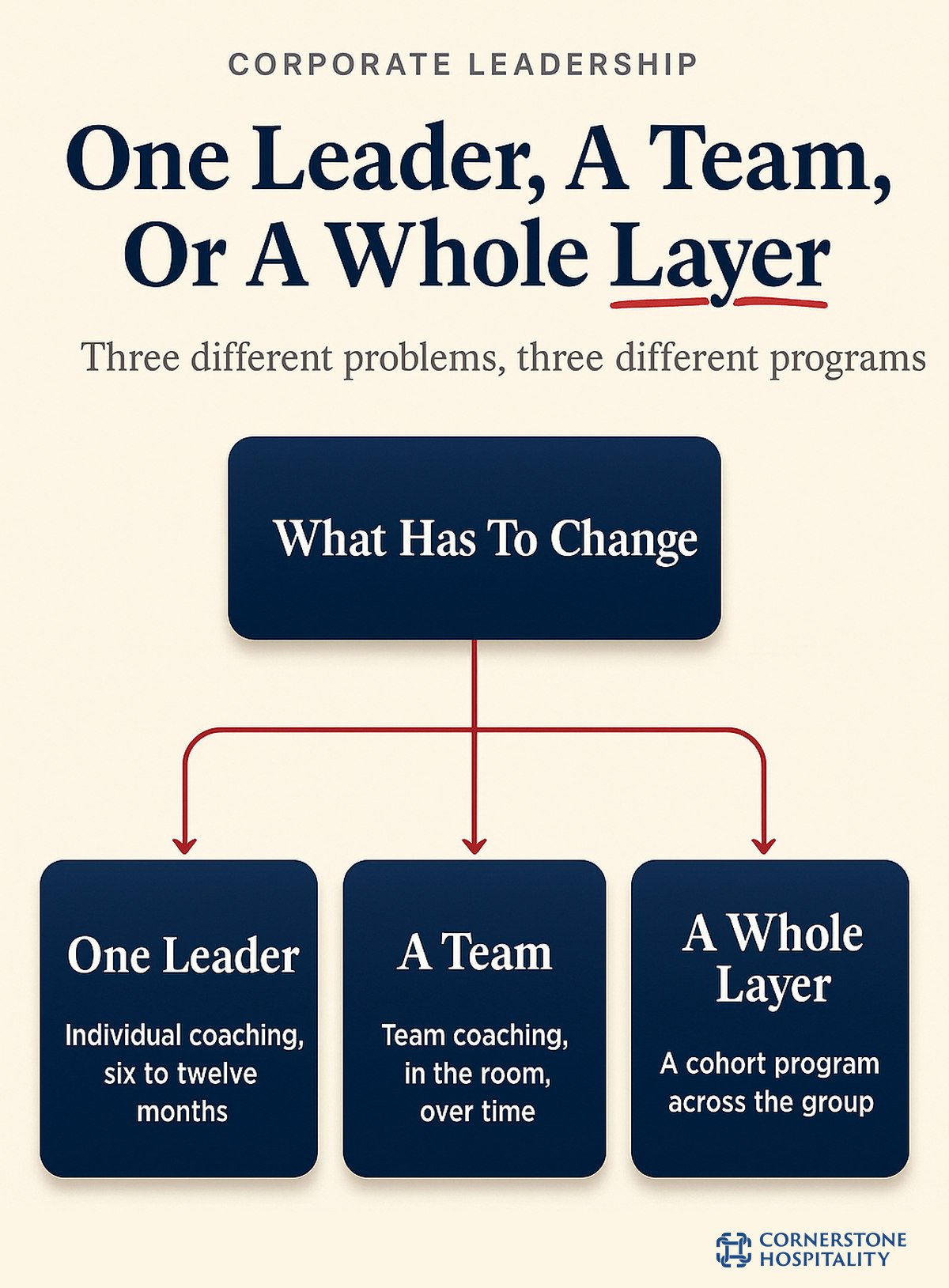
| One leader | A single person is the constraint, usually newly appointed or newly stretched | Individual coaching, six to twelve months |
| A team | The talent is there but the team does not challenge each other honestly | Team coaching, in the room, over time |
| A whole layer | The bench is thin and the group keeps buying leadership in | A cohort program across properties |
Groups often arrive asking for the third, and the conversation frequently lands on one of the first two instead.
Choosing between corporate leadership programs
The three routes solve genuinely different problems rather than being tiers of the same product. Matching the route to the problem is worth the time it takes, because the wrong one costs a year.
Individual coaching is the right answer when one named person is the constraint. It is precise, it is accountable to a written plan, and it is the wrong tool for a cultural problem that happens to show up in one person’s behavior.
Team coaching is the answer when the individuals are capable and the collective is not. That work happens with the team in the room over time, combining work on dynamics with individual coaching.
A cohort program is the answer when the bench is the problem, and the group cannot promote from inside because nobody is ready. It is the slowest to show a result and the only one that changes the shape of the organization.
How corporate leadership programs are put together
Diagnose the layer
Who is actually in the cohort, what each of them is being prepared for, and what the group is short of.
Build to the context
Designed around your brand standards, your ownership expectations and your stage of growth, not a stock curriculum.
Measure against the plan
Named outcomes agreed at the start, three milestone reviews, and an honest read at the close.

Frequently asked questions about corporate leadership programs
How big should a cohort be?
Small enough that every person gets individual attention inside the program. The number matters less than whether the group is at a comparable level, because a cohort that spans too many layers stops being useful to any of them.
Can a program run across several properties or countries?
Yes. The partner network across roughly 60 offices in 40 countries means a resident consultant can join the work in each market, while the plan, the targets and the reviews stay the same wherever the leaders sit.
How is progress measured?
Against named outcomes agreed before the program starts, reviewed at three milestones. If the behavior named at the start has not moved, that is the finding, and it is more useful than a satisfaction score.
How does this differ from training?
Training delivers content to a room, and it does that well when the content is the thing that is missing. This starts from a diagnosis of what the group is short of and works on that, which is why two cohort programs for two groups rarely look the same.
Who delivers it?
Consultants who carried operating responsibility in hospitality before moving into development work, supported by ICF-credentialled coaches.
What happens when the program ends?
The test is whether the group can promote from inside afterwards. That shows up in who fills the next vacancy rather than in the closing report.
Strengthening a whole layer, not just one leader?
Start with a conversation about the group and the bench. We will tell you which of the three routes actually fits.
Sources and references
- Training magazine, 2025 Training Industry Report: records that “U.S. training expenditures jumped 4.9 percent to $102.8 billion in 2025” and that “organizations spent $874 per learner this year compared with $774 per learner in 2024”, while average training received fell to “40 hours of training per year vs. 47 hours last year”. Management and supervisory training took 13 percent of the average budget. The survey covers a weighted universe of 152,572 US companies with 100 or more employees.
- CIPD, Learning and skills at work: surveys over 1,200 respondents and finds that “only a third of L&D professionals say they are proactive in identifying performance issues before recommending a solution”, with only a quarter designing learning using evidence-informed principles. It also records around a third of organizations reporting reductions in budgets, learning and development headcount and use of external consultants, only 18% expecting investment to return to pre-pandemic levels, and 72% reporting they can effectively tackle skills gaps.