

Restaurant Executive Recruiters: Senior Leadership for Restaurant Groups and F&B Portfolios
Retained executive search for the sub-vertical that runs on culinary productivity, beverage margin, and multi-unit scale.
The senior restaurant leader is a different animal
Beverage margin, culinary productivity, franchise scale, delivery economics.
Restaurant executive recruiters operate in a sub-vertical of hospitality with its own operating grammar. A senior restaurant leader who can hold that grammar is a different candidate profile from a hotel GM. Furthermore, finding them requires a search team that reads the sub-vertical fluently.
Cornerstone Hospitality‘s restaurant executive recruiters run retained searches at CEO, COO, VP Operations, VP Culinary, and multi-unit GM level for restaurant groups, quick-service brands, lifestyle F&B concepts, and hotel groups with significant restaurant portfolios.
Reading the sub-vertical: what a restaurant recruiter maps
The four operating dimensions our team maps before any shortlist is built.

A specialist maps all four before the shortlist lands on your desk.
Sub-vertical fluency from the first day of the brief.
What a restaurant executive recruiter should be reading
1. The multi-unit operator versus the flagship operator
A great flagship, restaurant GM is a different person from a great regional multi-unit VP. The flagship operator delivers a signature experience at one location; the multi-unit leader delivers consistency, cost discipline and unit economics at scale.
2. Beverage margin and culinary sourcing as leadership signals
The senior candidate who moved a group’s beverage margin four points in eighteen months, or reset the culinary sourcing to open a step-change in food cost, is a candidate the sub-vertical knows.
3. Franchise scaling versus corporate owned scaling
Franchise growth requires the ability to sell the model, support operators and hold brand standard at arm’s length. Corporate owned scaling requires operating depth. A senior candidate who has excelled at one and been assumed to succeed at the other is where searches fail.
4. Delivery channel economics
The senior restaurant leader in 2026 has to hold delivery channel economics inside their operating model, a completely different P&L discipline from the dine-in operator of ten years ago.
Restaurant roles Cornerstone places
| Category | Roles |
|---|---|
| Corporate leadership | CEO, President, COO, CFO, Chief Development Officer, Chief Marketing and Growth Officers |
| Operations and culinary | VP of Operations, VP of Culinary, Executive Chef leadership, VP of F&B for hotel groups with major restaurant portfolios |
| Multi-unit management | Regional VPs, Multi-Unit General Managers, Area Directors, Franchise Business Consultants |
| Board and governance | Non-executive directors, committee chairs, CEO successors for family-held, PE-held and public groups |
How a Cornerstone restaurant search runs
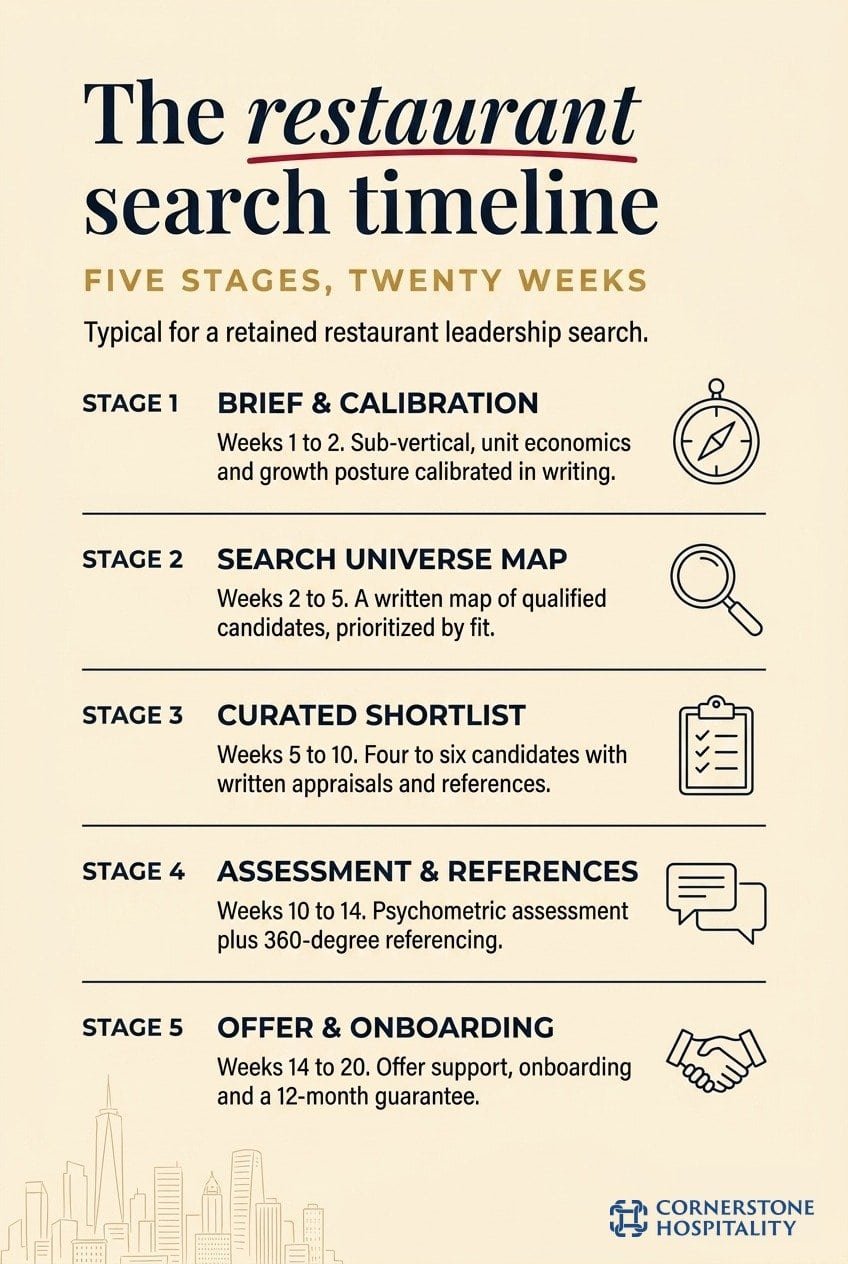
Sub-vertical, unit economics and growth posture calibrated in writing.
Scope, fee structure, exclusivity and confidentiality agreed in writing.
Written map of qualified candidates including passive talent, prioritized by sub-vertical fit.
Four to six candidates with written appraisals, competency-mapped interviews, initial references.
Psychometric assessment plus 360-degree references from peers at comparable scale.
Offer support, 90-day check-in, and a 6-12-month replacement guarantee.
What our restaurant clients say
“Cornerstone read our sub-vertical fluently from the first call. Their shortlist landed with four operators who could genuinely run our unit economics.”
“We needed a VP Culinary who could hold both the flagship and the multi-unit line without losing either. The Cornerstone team knew who that was inside two weeks of the brief.”
What Cornerstone’s restaurant executive recruiters read in every brief. The four sub-vertical grammars: multi-unit operations, beverage margin, franchise scale, and delivery economics. Because these differ across concepts, the shortlist must differ too.
What sets specialist restaurant executive recruiters apart. Specialist restaurant executive recruiters read the sub-verticals inside restaurant leadership and shortlist against them. In addition, that reading shapes the search from brief to references.
Where restaurant executive recruiters add the most leverage. Confidential replacements, multi-unit expansion, beverage director hires, and franchise leadership. Above all, the specialist approach is built to deliver the outcome.
How specialist restaurant executive recruiters run a search
Firstly, we read the brief against the four sub-vertical grammars. Furthermore, we pressure-test the operator’s assumptions. In addition, we map the target market. Consequently, the longlist reflects real signals, not just LinkedIn availability.
Secondly, we interview against the sub-vertical grammar. Because that grammar is where the operator will actually spend the next three years. Therefore, every appraisal speaks the language of the role.
Thirdly, we hold confidentiality tight. Because the current employer often does not know. Therefore, disclosure risk is real. In addition, we brief candidates on confidentiality before we brief them on the role.
Finally, we stay engaged through onboarding. As a result, the leader lands. Above all, the operator gets the outcome, not just the hire.
Quick summary
First, restaurants split into sub-verticals. Second, each sub-vertical has its own grammar. Third, that grammar must be read at brief. In addition, retained search matches the risk profile. Furthermore, confidentiality is non-negotiable. Meanwhile, specialist restaurant executive recruiters shortlist against those sub-verticals. Therefore, the shortlist fits the role. As a result, the leader lands. Consequently, the operator gets the outcome. Above all, the restaurant keeps its momentum.
The short answer
First, the sector matters. Second, the cadence matters. Third, the outcome matters. However, the specialist approach lands all three. Because the sub-sector grammar is real. Therefore, reading it at brief matters. Furthermore, retained search aligns the incentive with the outcome. In addition, written milestones anchor progress. As a result, the leader ships. Moreover, the team ships. Also, the operator keeps their standing.
Frequently asked questions about restaurant executive recruiters
What do restaurant executive recruiters do?
Retained executive searches for senior leadership of restaurant groups, hospitality operators with F&B portfolios, quick-service brands, and lifestyle F&B concepts.
What makes restaurant executive search a specialist discipline?
Restaurant leadership is its own operating discipline: beverage margin, culinary productivity, franchise scaling, and delivery channel economics.
When does a restaurant group need a retained recruiter?
When the role is senior enough that mis-hire cost is material, the incumbent is confidential, an expansion is on the timeline, or the strongest candidates are already in demanding jobs.
What restaurant roles does Cornerstone place?
CEO, President, COO, CFO, Chief Development Officer, VP of Operations, VP of Culinary, VP of F&B, Chief Marketing and Growth Officers, multi-unit and regional GMs, board directors.
How does confidentiality work?
Every approach is discreet by default. Blind search is available where the client is replacing an incumbent.
What is the fee structure?
Retained search on a staged fee. First-stage retainer, second-stage at shortlist, completion at signed offer. 6-12-month replacement guarantee.
Engage a specialist restaurant executive recruiter
Book a confidential call with a senior consultant. We will walk through the role, the sub-vertical calibration, and the retained fee structure. No obligation to proceed.
Return to Executive & Board Search overview
Cornerstone’s restaurant executive recruiters read the four sub-vertical grammars in every brief: multi-unit, beverage margin, franchise scale and delivery economics.