

What makes a good Leadership Program for Hospitality
What separates an executive leadership program for hospitality from a generic corporate course? Here is how to tell the difference before you commit budget to one.
Leadership programs for hospitality start with the sector’s own operating pressures. Their designers do not adapt them from a general corporate course after the fact.
Cornerstone Hospitality works with hotel groups, resorts, restaurant companies, and travel operators. Their senior leaders develop while the business stays open. Guests are in the building, and the team is watching how they handle the next interruption. Organizations worldwide spend more than $370 billion a year on leadership development. However, most of that content began life as material for a general corporate audience. In fact, nine in ten organizations invest in some form of it. Yet only one in ten can clearly demonstrate the value it delivers. That gap is evidence of a mismatch. Providers sell a lot of leadership development that never suited the buyer’s actual need.
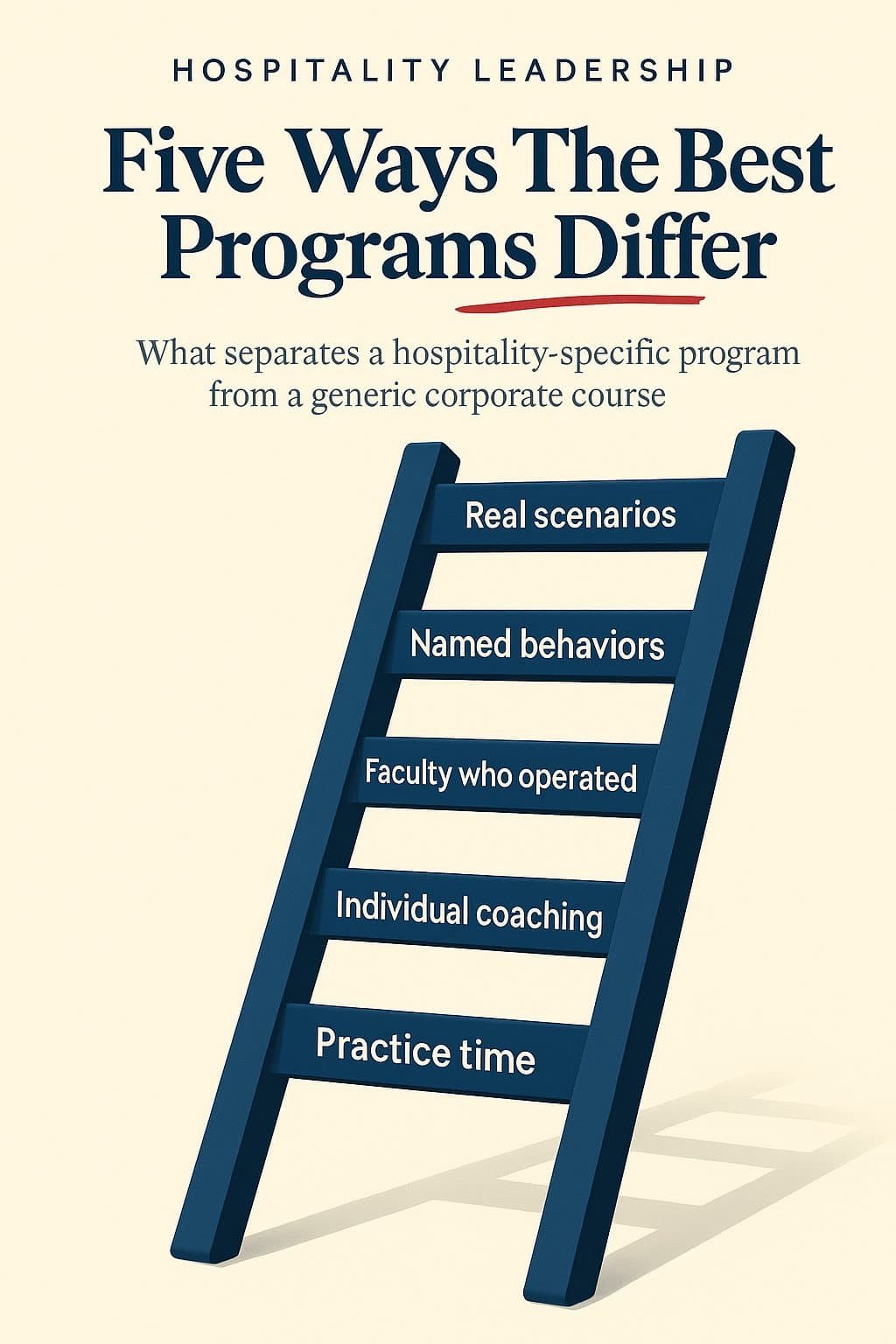
Five things that separate the best hospitality leadership programs from a generic course
Most providers write leadership development content once and sell it many times. That is a reasonable business model for the provider but a real risk for the buyer. The adaptation to a specific industry often happens at the level of examples and case studies. It rarely reaches what the program sets out to change. So a program built for hospitality’s own operating pressures looks different at five specific points.
It draws on real operating scenarios, not abstract case studies with the names swapped. For example, a generic program teaches negotiation with a manufacturing supply contract and delegation with a software team. A hospitality leader spots the disconnect immediately. Individual coaching runs alongside any group curriculum because a room of twenty people cannot address what any one of them individually needs to stop doing. A shared curriculum is efficient for building a common leadership language. On its own, though, it is a poor tool for changing one person’s specific behavior.
The other three practices to look for
Faculty have actually run hospitality operations, not just facilitated a licensed curriculum. Credibility in front of a room of general managers comes from having stood in their position, not from studying it. The program measures progress against named, specific behaviors rather than a satisfaction score. Just “better leadership” as a goal gives you nothing to measure. But you can measure “Delegates the weekly labor schedule instead of building it personally” by whether it happened. It runs long enough for practice to happen between sessions. A single two-day offsite produces energy and very little lasting change. So the property itself is the site of learning between sessions, not the training room during them.
Why hospitality needs a different standard
General leadership advice assumes a working environment most hospitality operations do not have. More than half of hoteliers report their properties are somewhat or severely understaffed. For 42% of operators, workforce shortages are a top financial concern. For example, a generic program assumes leaders can step away for a week without the business noticing. In practice, hospitality is rarely offered that week.
A third of hotel general managers stay in the role for only one to two years. Also, four in five held the responsibilities informally before they carried the title. The window to build a leader’s capability before they carry full accountability is short. That is exactly why the runtime and the coaching model of a program matter as much as its content.
Comparing programs for your senior team
Tell us who you are developing and toward what role. Then we will tell you honestly whether a leadership program for hospitality is the right tool, and what it should actually contain.
What to check before you commit a budget
You can evaluate a leadership program for hospitality before you sign a contract, through direct questions to the provider.
| What to check for | What a strong answer sounds like |
|---|---|
| Where do the scenarios come from | Real property situations described specifically, not a generic business case with the names changed. |
| Who is teaching it | Faculty who have carried a budget or run a property not only facilitated a licensed curriculum |
| Is there one-to-one coaching or only group sessions | A defined number of individual sessions, not “coaching available on request” |
| How is progress measured | Two or three named behaviors, checked at defined intervals, not a satisfaction score on the final day |
| How long does it run | Months, with practice between sessions, not a single offsite compressed into two days |
What the evidence says about coaching versus classroom time
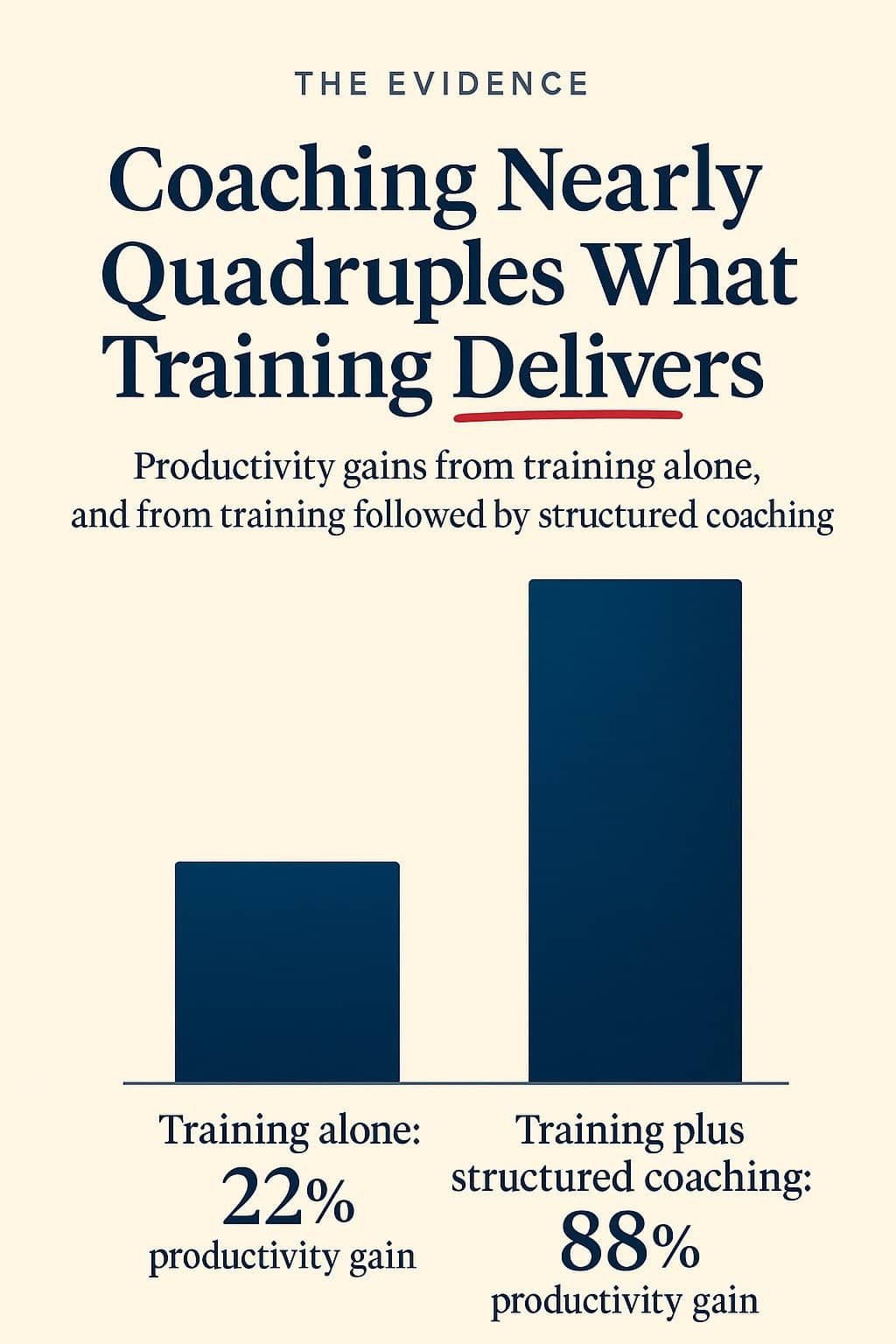
The clearest evidence on this question is older than the current market for leadership programs, and it has held up. A classic study of managers in a public sector agency measured productivity before and after a standard training program. It then measured productivity again after eight weeks of one-to-one coaching layered on top. First, training alone produced a 22.4% productivity gain. However, training followed by coaching produced an 88.0% gain, a substantially larger result from the same starting point.
In short, more recent research points in the same direction without contradicting it. Across a wide survey of coaching practitioners and clients, 87% agreed executive coaching delivers a high return on investment. Separately, a study from PricewaterhouseCoopers and the Association Resource Center found an average return of seven times the cost of the coaching engagement. Beyond that, almost three in four respondents linked coaching directly to stronger employee engagement. Also, approval of coaching ran at 78% among senior executives and 73% among employees. This suggests that the people being coached feel the effect. So do the people they manage.
What this means for your budget
Still, none of this argues that classroom content has no value. Instead, it argues that classroom content without a coaching layer is the weaker half of a program that could include both. The evidence for that gap is now old enough and repeated enough across different studies to be difficult to ignore. So it should weigh heavily in how you allocate a budget between the two.
Group program, individual coaching, or both
A shared curriculum works when the gap is shared
Several leaders develop at once with a genuine common gap. For example, newly promoted supervisors who have never had to hold a difficult conversation with a peer.
Individual coaching works when the gap is specific
One general manager who struggles with an owner relationship, and another who avoids delegating labor scheduling. So the content that helps one is close to irrelevant to the other.

Frequently asked questions
What makes a leadership program hospitality-specific rather than generic with a hospitality label?
The scenarios come from real property, floor, or kitchen situations, not a general business case with the names changed. Also, faculty have actually run hospitality operations. Progress counts against named, specific behaviors rather than a satisfaction score. Coaching for one person also runs alongside any group content.
Is a group program or individual coaching the better investment?
It depends on whether various leaders share the development need or it belongs to one person’s role and situation. So a group program builds a common language efficiently. One-to-one coaching, however, does the harder work of making a specific behavior change stick.
How long should an effective leadership program for hospitality run?
Long enough for repeated practice between sessions, typically months rather than days. A single offsite produces energy but rarely lasting change. That is because behavior change requires feedback on real attempts in the actual job.
Does this apply to a general manager developing informally before an official promotion?
Yes, and arguably more so. A third of hotel general managers stay in the role for only one to two years. In fact, most were already carrying the responsibilities before they held the title. In short, waiting for the formal title before starting development starts later than the job already has.
Considering a leadership program for someone senior?
It might be one leader, a pair, or a whole executive layer. Either way, start with a confidential conversation about what the business needs to be different. No commitment, no charge.
Related leadership development pages
This connects directly to our Leadership Development practice.
Sources 1 to 3: the size of the market and why most of it misses
- DDI: ROI of Leadership Development: reports that organizations worldwide spend “$370+ billion annually” on leadership development, and argues that many programs fail because they are measured against completion and satisfaction rather than concrete business outcomes such as retention, productivity, and safety: ddi.com/blog/roi-of-leadership-development
- Duarte, summarizing McKinsey research: Why Leadership Development Programs Fail: cites McKinsey’s finding that “while 90% of organizations invest in leadership development, only 10% feel they see clear ROI”: duarte.com/blog/why-leadership-development-programs-fail
- American Hotel & Lodging Association: Rising Cost, Staffing Challenges Persist for Hotels as Travel Demand Expected to Hold Steady: surveys 246 hoteliers in late February 2026 and finds that “more than half of respondents report their properties are somewhat or severely understaffed”, with workforce shortages named by 42%: ahla.com/news/rising-cost-staffing-challenges-persist-hotels
Sources 4 to 6: the manager’s effect on the team, and the evidence on coaching
- Gallup: Managers Account for 70% of Variance in Employee Engagement: draws on research covering 27 million employees and more than 2.5 million work units over two decades, finding that “managers account for at least 70% of the variance in employee engagement scores across business units”: news.gallup.com/businessjournal/182792/managers-account-variance-employee-engagement
- OysterLink: 20 Statistics About Hotel General Managers + Demographics: reports that 34% of hotel general managers remain in the role for only “one to two years”, and that “80% of Hotel General Managers worked in the role before they got the official title”: oysterlink.com/career/hotel-general-manager/demographics
- Olivero, Bane and Kopelman, Executive Coaching as a Transfer of Training Tool: Effects on Productivity in a Public Agency, Public Personnel Management, 1997: a study of 31 managers finding that a conventional managerial training program increased productivity by 22.4%, and that eight weeks of one-to-one executive coaching added on top increased productivity by 88.0%: journals.sagepub.com/doi/10.1177/009102609702600403
Sources 7 and 8: coaching ROI and the state of formal training
- International Coaching Federation: Coaching Statistics: The ROI of Coaching in 2024: reports that “87% of survey respondents agreed that executive coaching has a high return on investment”, citing a PwC and Association Resource Center study finding “an average ROI of seven times the cost” of coaching: coachingfederation.org/blog/coaching-statistics-the-roi-of-coaching-in-2024
- Association for Talent Development, 2025 State of the Industry report, as reported by Absorb: finds “90% of companies offered managerial and supervisory training, and 69% provided executive development”: absorbai.com/blog/atd-state-of-industry-report-takeaways