

Hotel Executive Onboarding Program
Hotel executive onboarding is the part almost everyone skips. The appointment is the easy part; the first ninety days decide whether it was a good one.
A hotel executive onboarding program exists because the most expensive part of a senior appointment is not the search. It is the first ninety days, and those are usually left to look after themselves.
Cornerstone Hospitality runs structured onboarding for newly appointed general managers, executive committee members, and regional leaders. Our consultants held these seats before moving into search, which is why the support is about the parts of arriving that nobody writes down.
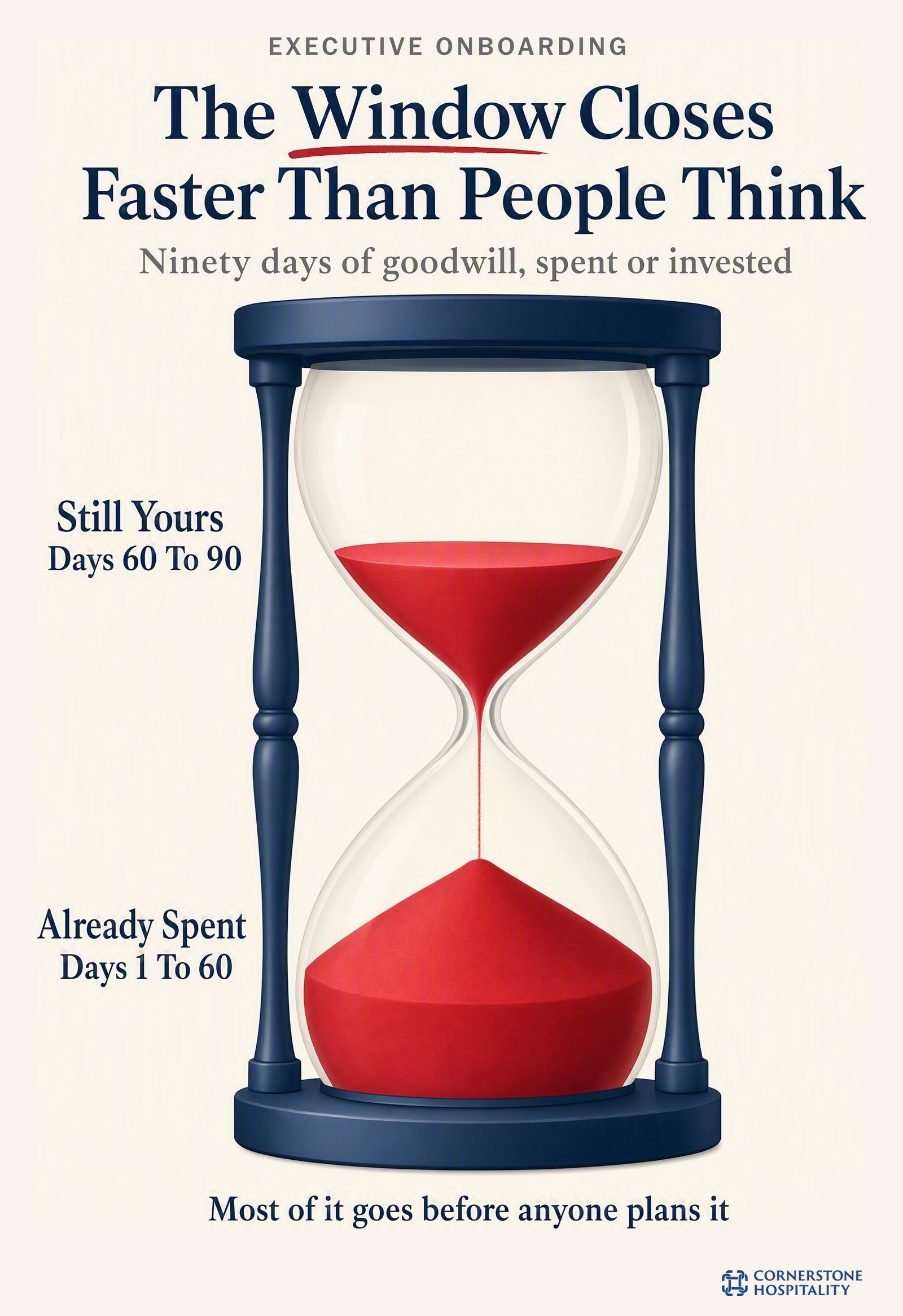
The window closes faster than people think
A new executive arrives with a stock of goodwill that will never be that high again. Every person in the building is willing to explain something, forgive something, and give the benefit of the doubt.
That stock depletes on a schedule nobody controls. By day sixty most of it is gone, spent on settling in, meeting people, learning systems, and being visibly new. What is left is a much smaller amount of patience.
The difference between a strong first year and a difficult one is almost always what happened to those first sixty days. Not whether they were busy, everyone is busy, but whether they were spent on the things that compound or on the things that merely fill a diary.
Onboarding is simply the decision to spend that window purposely rather than by accident.
Why strong appointments come undone without hotel executive onboarding
Very few senior appointments fail because the person could not do the job. They fail because of something in the first quarter that nobody named while it was still small.
A relationship with one owner that started badly. A predecessor’s decision that got inherited without being examined. A team member who was passed over and has quietly decided how this will go.

Hotel executive onboarding for someone senior starting soon?
Tell us who is arriving and into what, and we will tell you where the risk actually sits.
What hotel executive onboarding covers and what induction does not
Most groups have an induction. Very few have an onboarding program.
| Corporate induction | Executive onboarding | |
|---|---|---|
| Runs for | The first week | Ninety days |
| Covers | Systems, policy, and compliance | Relationships, priorities, and judgment calls |
| Delivered by | Human resources | Someone outside the reporting line |
| Can be told | What the executive is comfortable saying | What they cannot say to their own boss yet |
| Ends when | The forms are signed | The first hundred days are behind them |
Both are worth having. Only one of them is about whether the appointment works.
What a new leader has to get under
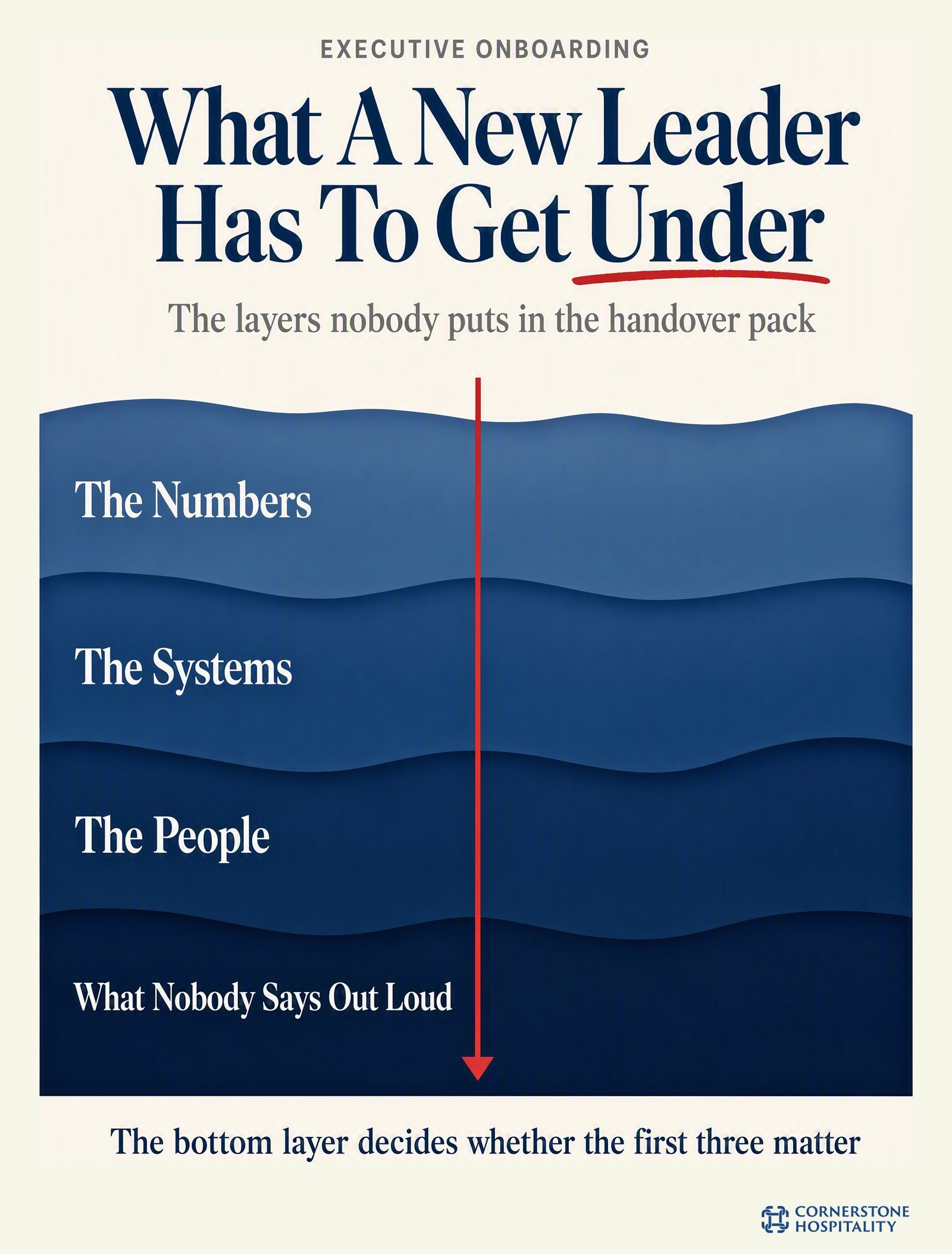
Every arriving executive works down through four layers, and most handover packs stop after the first two.
The numbers come first and are the easiest, because they are written down and somebody is paid to explain them. The systems are next, slower but still documented, and a competent leader gets through both inside a month.
The people take a full quarter. Not the org chart, which takes an afternoon, but who actually decides things, who is owed something, who has been waiting for this seat, and who the owner rings when they want an unofficial read.
Underneath all of it sits the layer nobody puts in writing. The reason the last person left. The subject that ends conversations. The commitment made two years ago that everybody is still working around. Reaching that layer early is most of what onboarding is for.
How hotel executive onboarding runs across ninety days
Before day one
A session before they start on what they are walking into and what to do in the first fortnight rather than the first year.
Days 1 to 60
Fortnightly sessions while the goodwill is still high, aimed at the relationships and the inherited decisions.
Days 60 to 90
Monthly, plus a review with the sponsor on what is settled, what is not, and what still needs attention.

Frequently asked questions about hotel executive onboarding
What is a hotel executive onboarding program?
Structured support for a newly appointed senior leader across their first ninety days, delivered by someone outside their reporting line. It covers the relationships, the inherited decisions, and the judgment calls that an induction does not touch.
When should it start?
Before day one, ideally. The most useful single session usually happens in the fortnight before they arrive while they can still plan how to spend the goodwill rather than discovering afterward where it went.
Who pays for it, the business or the executive?
Almost always the business, because the business carries the cost if the appointment does not settle. It is a fraction of the cost of running the search again.
Does the sponsor hear what is discussed?
Not the content. The sponsor gets two reviews on what is settled and what still needs attention. What the executive says about a colleague, an owner, or their own uncertainty stays in the session, which is the entire reason the session works.
Do you onboard executives you did not place?
Yes, and it is a substantial part of this work. Internal promotions in particular are often given the least support and carry more risk than people assume, because everyone treats the person as already inducted.
What if problems surface that onboarding cannot fix?
Then the program has done something valuable in month two rather than month fourteen. We will say plainly when an issue is structural rather than developmental and what the business should do about it.
Protecting an appointment you have just made?
If someone senior is starting in the next quarter, a conversation now is worth considerably more than one in six months. No commitment, no charge.
Sources and references
- The Future Organization, interview with Michael Watkins, The First 90 Days: Strategies for Leaders in Transition: records Watkins stating that “unaided the process for leaders to reach the breakeven point can take up to six months”, the breakeven point being where a leader contributes as much value as they have consumed. He also observes that “most people spend 10 to 15 years in leadership positions before getting any formal leadership training from their organization”, with the average leader in their late thirties or early forties before any training at all.
- Leadership IQ, Executive Failure Rates: reports a longitudinal study of more than 20,000 new hires across 312 organizations, evaluated by 5,247 hiring managers at 6, 12, 18 and 24 months, finding that “46% of new hires failed within 18 months; only 19% achieved unequivocal success” and that 89% of failures were attributable to attitudinal factors against 11% for technical skill. The leading drivers were coachability at 26%, emotional intelligence at 23%, motivation at 17% and temperament at 15%.
For the broader picture this fits into, see our Leadership Development work.